Dental Implant vs. Dental Bridge: Which Tooth Replacement Option Is Right for You?
Dental implant vs. dental bridge: learn how they differ, their benefits, costs, treatment process, and which tooth replacement option may fit your needs.
Losing a tooth can affect more than your smile. A missing tooth may make chewing less comfortable, change how your remaining teeth come together, and leave you wondering about the best way to restore your smile.
Two common tooth replacement options are dental implants and dental bridges. While both can replace a missing tooth and restore function, they work in very different ways.
At Aligned Dental House, we believe every smile is different. The right treatment depends on your oral health, the condition of your gums and jawbone, the location of the missing tooth, your goals, and your long-term needs.
In this guide, we'll explain the differences between a dental implant and a dental bridge so you can have a more informed conversation with your dental team.
Quick Answer
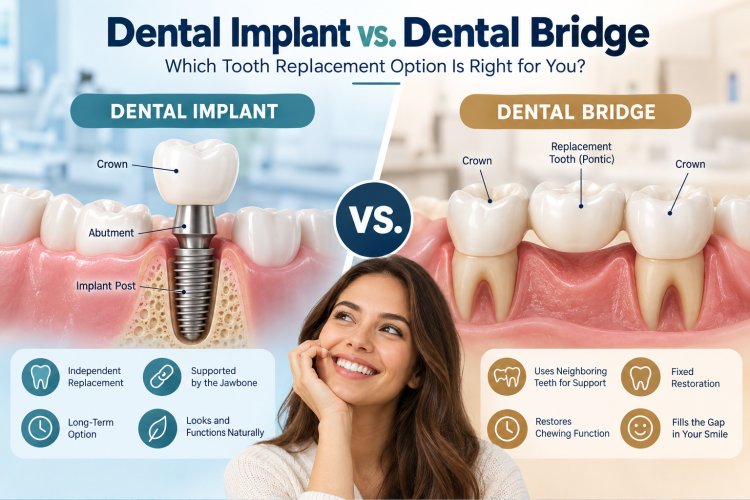
A dental implant replaces a missing tooth by using an implant post placed in the jawbone, which supports a dental crown. A dental bridge replaces a missing tooth by using neighboring teeth or dental structures for support.
Neither option is automatically right for every patient.
Dental implants may be considered when a patient wants an independent tooth replacement that does not rely on neighboring teeth and has suitable bone and gum health. A dental bridge may be an appropriate option when a fixed restoration supported by neighboring teeth is preferred or when an implant is not the right choice.
Your dentist can evaluate your smile and discuss which option is appropriate for your individual needs.
What Is a Dental Implant?
A dental implant is a tooth replacement option designed to replace the root portion of a missing tooth.
The implant is placed into the jawbone and, after the area heals, can support a dental crown that replaces the visible portion of the tooth.
Dental implants are commonly used to replace individual missing teeth and can also be incorporated into more extensive tooth replacement plans.
At Aligned Dental House, periodontal care includes dental implants, gum treatment, bone and gum grafting, and other treatments related to missing teeth and oral health. You can learn more about Periodontics & Dental Implants.
A dental implant generally consists of:
-
An implant post that serves as the tooth-root replacement
-
An abutment that connects the implant to the restoration
-
A dental crown designed to restore the appearance and function of the missing tooth
What Is a Dental Bridge?
A dental bridge is a fixed dental restoration used to replace one or more missing teeth.
Instead of placing an implant into the jawbone, a traditional bridge generally uses the teeth adjacent to the missing space as support. A replacement tooth, called a pontic, fills the space created by the missing tooth.
Dental bridges can restore the appearance of a smile while helping patients regain everyday chewing function.
Aligned Dental House includes bridges among its general and cosmetic dentistry services, along with crowns, fillings, veneers, and other restorative treatments. Explore the practice's General & Cosmetic Dentistry services to learn more.
Dental Implant vs. Dental Bridge: What Is the Difference?
The biggest difference is how each restoration is supported.
Dental Implant
A dental implant is anchored in the jawbone and is designed to replace the missing tooth's root.
Because the implant is independent of neighboring teeth, the adjacent teeth do not need to serve as the primary support for the replacement tooth.
Dental Bridge
A traditional dental bridge fills the gap created by a missing tooth and is supported by neighboring teeth.
This can make a bridge a practical fixed restoration for certain patients, depending on the health and structure of the surrounding teeth.
What Factors Matter?
Your dentist may consider:
-
The number and location of missing teeth
-
The health of your gums
-
The amount and quality of available jawbone
-
The condition of neighboring teeth
-
Your bite and overall oral health
-
Your treatment preferences
-
Your timeline and long-term goals
-
Your overall dental history
There is no single tooth replacement solution that works for everyone.
Benefits and Considerations of Dental Implants and Bridges
Understanding the potential advantages and considerations of each option can help you prepare for your dental consultation.
Potential Benefits of Dental Implants
Dental implants may offer:
-
An independent replacement for a missing tooth
-
A restoration designed to look and function like a natural tooth
-
Support from the jawbone rather than neighboring teeth
-
A long-term tooth replacement option when appropriate
-
The ability to replace a missing tooth without using adjacent teeth as bridge supports
However, implants require surgical placement and healing. Adequate bone and healthy oral tissues are important considerations, and some patients may need additional procedures such as bone grafting before implant placement.
Potential Benefits of Dental Bridges
Dental bridges may offer:
-
A fixed option for replacing a missing tooth
-
Restoration of chewing function
-
A way to fill a visible gap in the smile
-
A treatment approach that does not require implant placement
-
A solution that may be appropriate for certain patients based on their oral health and treatment goals
A traditional bridge relies on supporting teeth, so the condition of those teeth is an important part of treatment planning.
For any tooth replacement treatment, maintaining good oral hygiene and attending regular dental visits are important for protecting your smile. Regular dental visits can also help identify potential problems early. Learn more in How Often Should You Visit the Dentist? A Huntington Beach Dentist Explains.
What to Expect
The treatment process is different for dental implants and dental bridges, but both begin with an evaluation.
Step 1: Dental Examination and Treatment Planning
Your dental team will examine your teeth, gums, bite, and the area surrounding the missing tooth.
Depending on your needs, diagnostic imaging may also be used to evaluate the underlying structures and support treatment planning.
A comprehensive dental examination is an important part of understanding your available treatment options. You can learn more about examinations and restorative treatment in What to Expect From a General Dentist in Huntington Beach, CA.
Step 2: Discuss Your Treatment Options
Your dentist will explain the options that may be appropriate for your situation.
This is the time to ask questions about:
-
Treatment steps
-
Expected healing time
-
Oral hygiene requirements
-
Number of appointments
-
Restoration options
-
Long-term maintenance
-
Insurance and payment considerations
If you are preparing for your first visit, the New Patients page from Aligned Dental House explains what to bring and what you can expect during your appointment.
Step 3: Complete the Recommended Treatment and Follow-Up
Once you and your dental team decide on an appropriate treatment plan, the restoration process can begin.
Dental implant treatment may involve implant placement, a healing period, and placement of the final restoration.
Bridge treatment typically involves preparing the supporting teeth, creating the bridge restoration, and placing it once it has been completed.
Your dentist will provide specific aftercare instructions based on your treatment.
Dental Implants and Bridges in Huntington Beach
If you are looking for tooth replacement options in Huntington Beach, CA, choosing a dental office that can evaluate your overall oral health can make the process easier.
At Aligned Dental House, patients have access to comprehensive dental care and multiple specialties under one roof. The practice provides general and cosmetic dentistry as well as periodontal care, where dental implants and other treatments for missing teeth are offered.
The practice's approach combines advanced technology with personalized treatment planning and a patient-focused experience.
If you're researching local dental care, you can also read How to Choose the Right Family Dentist in Huntington Beach for Your Loved Ones.
Why Choose Aligned Dental House?
Choosing tooth replacement treatment is an important decision, and having a dental team that takes time to understand your needs can make the experience more comfortable.
Aligned Dental House focuses on:
-
Personalized care: Treatment recommendations are designed around each patient's individual needs and goals.
-
Comprehensive dental care: Multiple dental specialties are available in one practice.
-
Advanced technology: Modern diagnostic and treatment technology supports precise and comfortable care.
-
Patient-focused communication: The team emphasizes clear explanations and helping patients understand their options.
-
Family-centered care: The practice provides dental care for children, teens, and adults.
Aligned Dental House describes its approach as centered on comfort, trust, personalized treatment planning, and clear communication. You can learn more about the practice's philosophy on the About Aligned Dental House page.
Frequently Asked Questions
1. Is a dental implant better than a bridge?
A dental implant is not automatically better than a bridge for every patient. The appropriate choice depends on factors such as your gum health, jawbone, neighboring teeth, overall oral health, treatment goals, and individual circumstances.
2. How long does a dental bridge last?
The lifespan of a dental bridge can vary depending on factors such as oral hygiene, the health of the supporting teeth, bite forces, diet, and regular dental care. Your dentist can discuss expected longevity and maintenance based on your specific restoration.
3. How long does a dental implant take?
Dental implant treatment can take several months in some cases because the implant may need time to heal and integrate with the surrounding bone before the final restoration is placed. The timeline varies depending on your oral health and whether additional procedures are required.
4. Can anyone get a dental implant?
Not everyone is immediately ready for dental implant placement. Your dentist will evaluate your gums, jawbone, overall oral health, and other factors to determine whether an implant is appropriate. Some patients may require preparatory treatment before implant placement.
5. Is a dental bridge removable?
A traditional dental bridge is generally a fixed restoration rather than something the patient removes each day. Your dentist will explain the type of bridge recommended for your particular situation.
Conclusion: Dental Implant vs. Dental Bridge
When comparing a dental implant vs. a dental bridge, there is no universal answer.
Both can be valuable tooth replacement options, but they differ in how they are supported, how they are placed, and what may be required during treatment.
The best starting point is a professional evaluation. Your dentist can assess your teeth, gums, jawbone, bite, and overall oral health before explaining which options may fit your needs.
At Aligned Dental House, our goal is to make dental care feel comfortable, clear, and personalized. If you are dealing with a missing tooth and want to understand your options, our team is here to help you take the next step toward a healthy, confident smile.
Ready to explore your tooth replacement options?
Contact Aligned Dental House to schedule a consultation and discuss whether a dental implant, dental bridge, or another treatment option may be appropriate for your smile.
Contact Aligned Dental House
Aligned Dental House
6432 Bolsa Avenue
Huntington Beach, CA 92647
Phone: (714) 891-5245
Email: admin@alignbyme.com
Request an Appointment
What's Your Reaction?